
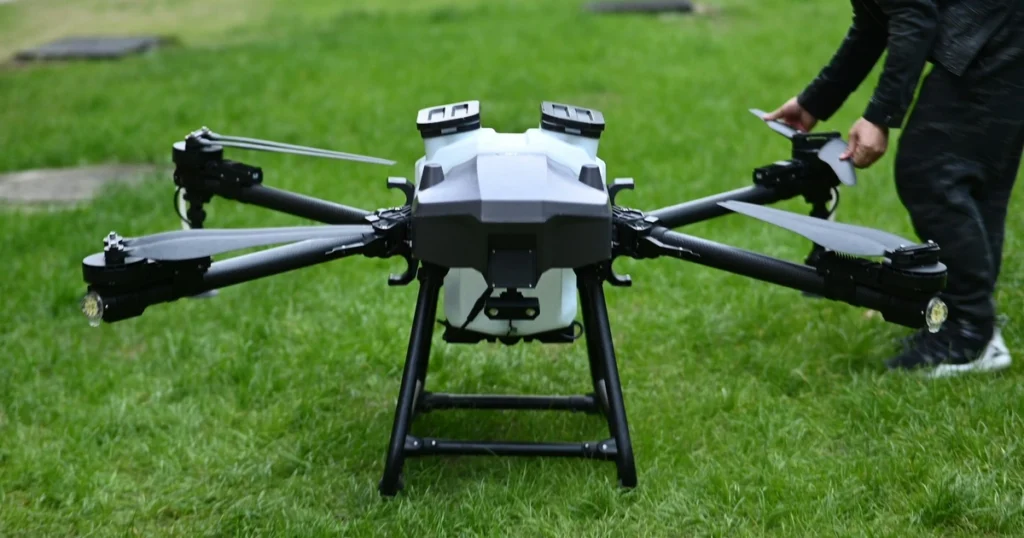
In the past decade, drones have moved from hobby gadgets to critical tools in global agriculture, reshaping how farmers grow food and manage land. A recent study published in Science by Michigan State University researchers Ben Belton and Leo Baldiga documented how agricultural drones have expanded at extraordinary speed — first across Asia, then into Latin America, North America, and Europe.
What they found confirms what PASUAV sees every day in Florida: drones are not the future of farming — they are the present.
From “Flying Cameras” to Flying Tractors
MSU researchers explain that early agricultural drones were small, costly, and difficult to operate. Today’s machines are the opposite:
- Ready to fly immediately
- Capable of carrying up to 220 pounds of fertilizer, seed, or spray
- Built as multifunctional platforms with interchangeable attachments
Globally, drones are now used for:
- Spraying crops
- Spreading fertilizer
- Sowing seeds
- Monitoring livestock
- Mapping drainage and soil variability
- Measuring crop health
- Transporting produce
- Dispensing fish feed
- Even painting greenhouse panels
They have become, as the MSU team puts it, “flying tractors.”
At PASUAV, we see this same versatility driving adoption across Florida — especially in strawberries, citrus, blueberries, leafy greens, and high-value specialty crops.
Why the World Adopted Drones Faster Than Any Previous Agricultural Technology
Among the study’s most striking findings is how fast drones spread. Historically, major agricultural technologies — like tractors — flowed slowly from wealthy countries to middle- and low-income regions over decades.
Drones reversed this pattern completely.
- The first agriculture-specific quadcopter emerged from China in 2016.
- Today, over 250,000 agricultural drones operate in China alone.
- Thailand went from nearly zero drone use in 2019 to drones working 30% of all farmland by 2023.
- In the U.S., FAA registrations for agricultural drones jumped from 1,000 in early 2024 to over 5,500 by mid-2025 — with real numbers likely much higher.
Why the explosion?
Because drones solve problems that ground rigs, airplanes, and labor simply cannot — particularly in regions like Florida with:
- Tight spraying windows
- Dense, specialty cropping systems
- Weather volatility
- Labor shortages
- Flood-prone or uneven terrain
- Sensitive soils that suffer from compaction
Florida farmers need precision, speed, and flexibility. Drones deliver all three.
Benefits and Risks: What the MSU Study Reveals
According to Belton and Baldiga, the rise of agricultural drones brings both opportunities and considerations:
Major Benefits
- Reduced direct exposure to pesticides for farmers
- Less fertilizer and chemical waste
- Lower crop damage from ground equipment
- Reduced energy use compared to tractors
- Better coverage in hard-to-reach areas
- Opportunities for rural youth as drone pilots
Risks That Must Be Managed
- Drift concerns when drones are misused or uncalibrated
- Potential displacement of manual field labor
- Need for training and responsible operation
- Uneven adoption across regions
PASUAV addresses these challenges through RTK precision, professional piloting, proper calibration, and responsible treatment planning tailored to Florida’s environmental conditions.
Custom Application: Precision for Florida’s Most Valuable Crops
The MSU research notes that drones reduce waste and distribute seeds, nutrients, and sprays more evenly. PASUAV’s Custom Application service applies this science directly to Florida farming:
- RTK-guided accuracy places inputs exactly where needed
- No soil compaction or crop damage
- Ideal for groves, berries, vegetables, nurseries, and organic systems
- Faster response during fungal outbreaks, nutrient deficiencies, or post-storm windows
Drones let Florida growers treat hundreds of acres quickly while being gentle enough for small fields and high-value specialty crops.
Aerial Imaging: Data That Helps Grow More With Less
MSU researchers highlight drones’ mapping and monitoring abilities — essential tools for sustainable intensification. PASUAV integrates those insights through advanced imaging:
- NDVI and multispectral crop analysis
- Heat, stress, and irrigation mapping
- Drainage and topography modeling
- Pest and disease detection
- Construction, environmental, and storm assessment
Fast, accurate aerial data helps growers produce more food with fewer resources — the “holy grail” the MSU study identifies.
Drone Maintenance: Keeping Technology Flight-Ready
The study underscores the importance of reliability and safety. As drones replace traditional machinery, maintenance becomes just as vital as tractor servicing.
PASUAV provides:
- Routine inspections
- Software and firmware updates
- Calibration and RTK adjustments
- Repairs, parts, and emergency support
- Seasonal readiness for spraying and imaging windows
As technology becomes more integrated into farming, professional maintenance protects grower investments and uptime.
Are Drones Replacing Workers — Or Creating New Opportunity?
The MSU research raises an important point: drones can displace manual sprayers. In China, a drone can do the work of 30–100 workers per hour.
But the study also reveals a powerful countertrend:
- Drones create new skilled jobs
- Young people embrace drone piloting
- Rural communities gain new technical industries
PASUAV sees the same in Florida — drones are helping modernize agriculture, attract younger talent, and reduce dangerous manual tasks.
The Future: Sustainable Intensification
The MSU researchers conclude that drones may increase total food production per acre while reducing the inputs needed to grow it — a key goal for global agriculture.
Florida is positioned perfectly for this transformation.
With weather volatility, high-value specialty crops, and a need for rapid response after storms, drones are not optional — they are essential.
PASUAV is proud to be part of this shift, providing:
- Precision custom application
- High-resolution aerial imaging
- Professional drone maintenance and operational support
Backed by innovation, integrity, and a commitment to Florida’s growers.