
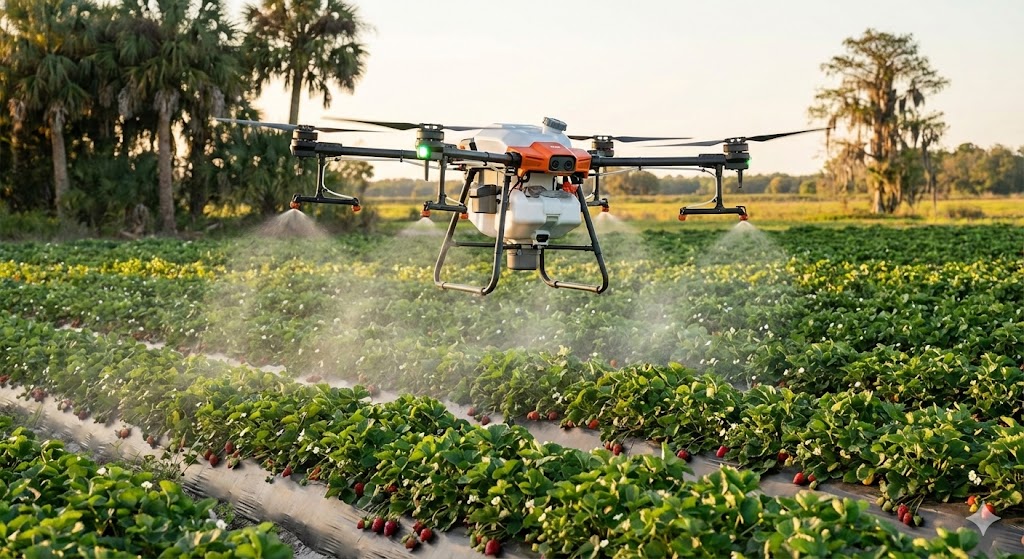
Across Plant City and the surrounding strawberry region, more growers are turning to drone spraying as they prepare for the 2025–2026 season. A few years ago, only a handful of early adopters were experimenting with spray drones. Today, it’s becoming a clear shift in how fields are managed. Rising labor costs, tighter spraying windows, and the need for cleaner, more uniform applications have pushed drones from “new idea” to “standard tool.”
Growers are seeing practical results in the rows, and the change is picking up speed.
The Push for More Efficient Spraying
Labor has always been a challenge during peak season, but the past two years have been especially difficult. Skilled sprayer operators are harder to find, and ground rigs require a full crew to run safely. When weather cuts spraying windows short, growers often don’t have the manpower to cover the necessary acreage quickly enough.
Drones solve that. A single operator can launch a drone and cover a field without a crew. There’s no tractor to maneuver, no need to drive through soft rows, and no risk of getting stuck after overnight rain. When disease pressure rises, drones let growers respond immediately.
Uniform Coverage Is Changing Outcomes
One of the biggest reasons growers are making the switch is coverage. The DJI Agras T40 delivers a consistent spray pattern from above the canopy, reaching areas that ground rigs often miss. When rigs pass through rows, the boom height changes, the ground shifts, and coverage becomes uneven. That unevenness is one of the main contributors to disease pockets forming later in the season.
A drone flies the same line every time. With RTK guidance, the pattern is precise, and the coverage is even across the entire block. Growers dealing with early-season disease pressure have seen the difference in canopy health, fruit development, and recovery after heavy rains.
No Soil Compaction, No Plant Damage
Strawberry plants don’t tolerate compaction well. Heavy equipment pressing into wet soil closes oxygen pathways, restricts root growth, and slows early-season establishment. In a year where weather swings sharply from wet to dry, those early setbacks matter.
Drones remove the equipment from the ground entirely. The rows stay untouched, the roots stay healthy, and the plants recover faster after storms. Growers who used drones last season noticed stronger stands and fewer weak pockets caused by repeated tractor passes.
The Timing Advantage
Florida’s humidity and morning dew create narrow windows for effective spraying. Ground rigs often can’t enter the field early enough, especially when rows are soft or ponded.
With drones, if the conditions are right, the job gets done. There’s no waiting for the ground to firm up. A drone can take off at first light and finish before the weather shifts. In seasons where fungicide timing makes the difference between clean fruit and spread, that timing advantage is critical.
Early Adopters Lead the Way in Plant City
Plant City growers have been among the first to embrace drone spraying in a serious way. The combination of tight plant spacing, soft early-season rows, and high disease pressure makes the region a perfect fit for aerial application. Farms that tried drones two or three seasons ago have continued using them because they saw clear improvements in canopy uniformity and overall yield stability.
As word spreads, neighboring farms are reaching out to learn how drones can be integrated into their programs. What started with a small group of early adopters has turned into a steady shift across the county.
A Practical Solution for a Fast-Changing Industry
The switch to drone spraying isn’t about replacing people or abandoning traditional equipment. It’s about giving growers another tool—one that fits the reality of Florida agriculture in 2025 and beyond. Weather is unpredictable, labor is tight, and disease pressure remains a constant challenge. Drones help growers stay ahead instead of playing catch-up.
PASUAV is seeing the trend firsthand. Each season brings more calls from growers looking for faster, cleaner, and more reliable application options. As the technology continues to advance, drone spraying is becoming a normal part of crop management, not an experiment.