
Why Timing Matters More Than Ever
Fungicide only works when it’s applied at the right moment. Florida growers already know how quickly disease pressure can build, especially in strawberries and citrus. What’s changing is how narrow the effective spraying window has become. Morning dew, humidity swings, and fast-moving weather patterns all play a role in whether a fungicide application actually does its job.
Drones are helping growers hit that window with far more accuracy than traditional ground rigs, and that accuracy is becoming one of the most important advantages in modern crop protection.
The Importance of Dew and Humidity
Every grower has seen what happens when fungicide is applied too late in the day. As the sun heats the plants, the leaf surface dries unevenly. Humidity rises and falls in short cycles, especially during Florida’s transition months. When the leaf surface isn’t at the right moisture level, coverage becomes inconsistent. This weakens the fungicide’s ability to adhere and penetrate where it needs to.
Early morning has always been the best time to spray, but that window is getting tighter. Some mornings offer only 45 minutes to an hour where the dew is light enough to avoid dilution but still present enough to help the canopy open up. Missing that window means less effective protection, and growers feel the impact in lost canopy health and reduced yield.
Why Ground Rigs Are Struggling With Timing
Ground rigs can do a lot of things well, but they struggle with timing. Soft fields, overnight rain, and heavy dew make it difficult or impossible to enter the rows when the conditions are perfect. By the time a tractor can get moving, the window is often gone. Even when the rig makes it into the field, tire tracks and soil compaction add another layer of stress to young plants.
In strawberries, missing the early window often means delaying until the next day. On a week with high disease pressure, that delay is enough for spores to spread across multiple rows. In citrus, it gives fungal pathogens more time to take advantage of weakened trees already dealing with greening.
How Drones Hit the Target Window
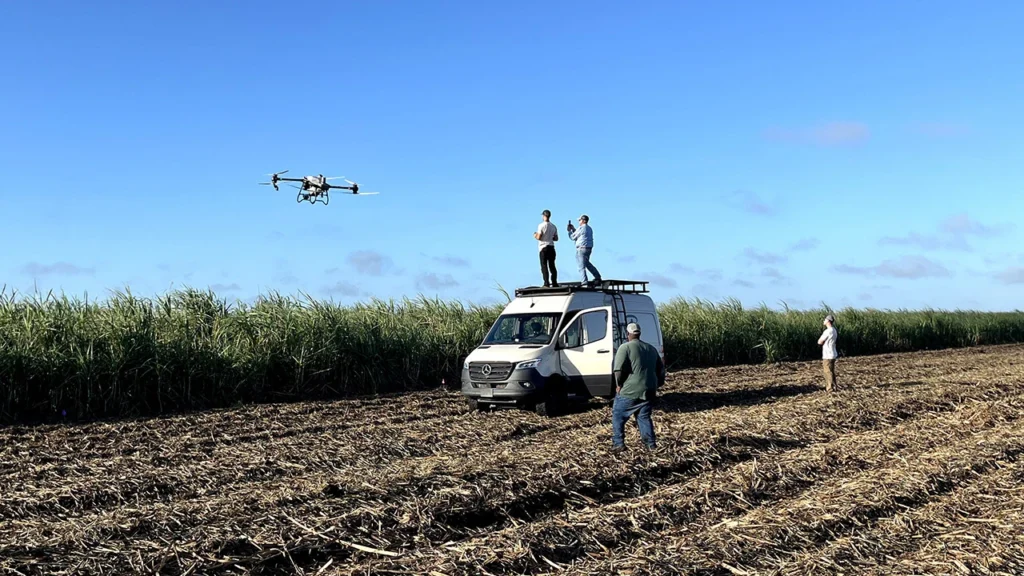
A spray drone doesn’t need the field to be dry, level, or accessible. If the air conditions are right, the drone can fly. That alone opens up opportunities that growers haven’t had in years.
Drones outperform ground rigs in several key ways:
- They can take off immediately at first light. There’s no warm-up period, no waiting for the ground to firm up, and no risk of getting stuck in soft soil.
- They apply evenly from above the canopy. This gives better coverage under leaf surfaces, where disease often starts.
- They reach areas that tractors miss. Wet rows, tight plantings, and soft sections are no longer obstacles.
- They avoid compaction entirely. Healthy roots and undisturbed soil help plants stay stronger throughout the season.
Because drones operate from the air, growers can treat problems during the exact moment the fungicide will be most effective. That timing advantage often means healthier plants, fewer outbreaks, and reduced chemical waste.
A Better Fit for Florida’s Weather Patterns
Florida’s humidity can swing sharply within a single morning. A drone can launch when conditions are ideal and finish the job before those swings impact efficacy. Ground rigs rarely move that fast. As weather patterns continue to shift, speed and flexibility are becoming essential tools for disease control.
What This Means for Growers
The timing gap is widening between farms that can hit the early spray window and those that can’t. Drones help close that gap. When disease pressure rises, fast and accurate application can make the difference between staying ahead of the problem or spending the next several weeks trying to recover lost ground.
PASUAV is already seeing this across Florida’s fields: farms that adopt precision aerial spraying maintain healthier canopies, use fewer rescue treatments, and have better consistency throughout the season.